 International
  Kenya
Kenya  South Africa
  Australia
  New Zealand
  China
China  Hong Kong
  Japan
Japan  Macau
Macau  Mongolia
  South Korea
  Taiwan
  Austria
  Belgium
  Czech Republic
  Denmark
  France
  Germany
  Ireland
  Italy
Italy  Netherlands
  Norway
  Poland
  Spain
Spain  Sweden
  Switzerland
  Turkey
  United Kingdom
  Saudi Arabia
  United Arab Emirates
  Canada
  Mexico
  United States
  Bangladesh
  India
India  Sri Lanka
  Cambodia
  Indonesia
  Malaysia
  Philippines
  Singapore
  Thailand
  Vietnam
 Offering a high quality of life, a great education system, and an excellent work-life balance, the Netherlands has become one of the most desirable European destinations for families, couples, and individuals alike. Plus, with the highest English proficiency globally among non-native speakers, the transition is significantly easier for UK expats.
Yet, while the Netherlands offers several benefits, a move to the Land of Tulips will take serious preparation: visas, housing, healthcare and daily life. Despite offering a high quality of life and favourable working patterns, your experience will depend on your reasons for moving, where you choose to live, and how early you plan.
In this piece, we break down what life in the Netherlands is like in 2026, providing practical settling-in tips and key information for those looking to make that move.
TL; DR: Een leven in Nederland
- The Netherlands is growing in popularity due to its high English proficiency, quality of life and safety rankings, and working culture
- You will need your Citizen Service Number to do many things, such as open a bank account, get employment, and access healthcare.
- Health insurance is mandatory in the Netherlands, so ensure you get this sorted as soon as possible.
- The education system in the Netherlands is slightly different to how it is in the U.K – be sure to familiarise yourself with this.
- Begin planning as soon as possible to secure housing, visas and integration support.
Before You Move: Visas post-Brexit
Since the UK left the EU, UK citizens can enter the Netherlands (and other Schengen area countries) visa-free for up to 90 days for tourism or short business stays in any 180 days.
As a result of Brexit, UK passport holders are now considered third-country nationals and must obtain a Dutch residence permit if they wish to reside in the Netherlands for more than 90 days. If you overstay your 90-day visa-free limit, you may be banned from entering Schengen countries for up to three years.
Types of residence permits include:
- Work (employed and self-employed)
- Family and partner
- Study
- Au pair and exchange
You must apply for a long-stay visa at least three months before your move.
If you’re planning on living in the Netherlands for more than four months, then you will need to register with the municipality in the Personal Records Database (Basisregistratie Personen, or BRP). For this, you will need a legalised and translated birth certificate.
Once registered, your local municipality will issue you a Citizen Service Number (Burgerservicenummer, or BSN). This will enable you to:
- Work
- Open a bank account
- Access health insurance
- Visit a doctor or hospital
- Apply for benefits.
You can apply for permanent residency in the Netherlands once you have had a valid residence permit for at least 5 consecutive years.
It’s key to start application processes early to avoid delays.
Cost of Living and Housing: How Much Does It Cost to Live in The Netherlands?
The Netherlands is known for its high quality of life, and fast becoming one of Europe’s top tech hubs, but this comes with a relatively higher cost of living in comparison to other European countries like Spain and Italy. Yet, in comparison to the UK, costs can be somewhat similar depending on where you move to.
Major cities like Amsterdam and Utrecht are often more expensive, so keep this in mind within your search.
Housing
Rent and housing costs depend on several factors, such as location and home type:
| Amsterdam | As the capital of the Netherlands, rents are significantly higher; a 1-bedroom apartment in the downtown area can cost around €2,105.81pm, whereas the same outside the city centre averages around €1,726.70pm. |
|---|---|
| Rotterdam | Known for being Europe’s largest port and the centre of modern architecture, Rotterdam offers a lively cultural life and maritime heritage. A one-bedroom apartment averages at €1,493.34pm, falling to €1,255.36pm outside the city centre. |
| Den Haag (The Hague) | Serving as the administrative centre of the Netherlands, Den Haag hosts parliament, the Royal Family and international courts. A 1-bed apartment averages around €1,519.85pm, or €1,198.01pm outside the centre. |
| Utrecht | A city known for its medieval centre and three-lined canals, Utrecht is the Netherlands’s historic hub offering a blend of ancient charm and modern culture – while being one of the world’s most bike-friendly cities! Housing is slightly cheaper than in the capital, averaging €1,645.25pm within the city centre and €1,337.56pm outside. |
| Haarlem | Situated close to the capital and within proximity to the Dutch tulip fields (Bollenstreek), Haarlem is known as the heart of the flower-bulb region and offers a quieter alternative to Amsterdam. A 1-bedroom apartment in the downtown area averages at €1,512.12pm, and €1,319.40pm outside the centre. |
Buying property varies dramatically by region, with urban centres costing significantly more than rural countryside and towns.
Utilities
While utilities will vary depending on home size, location and energy consumption, utility costs for an apartment in the Netherlands typically range between €150 and €300 for gas, electricity and water, with internet fees adding an additional €40-70 a month.
Most Dutch homes use electricity as their main source of power; gas is an option in many homes, too.
Below is the breakdown of average monthly costs:
- Electricity (incl. heating): €50
- Gas (if used for heating/cooking): €140.
- Water: €15.71-€37.74 (depending on household size)
- If you own the house you live in, you will need to pay an additional water system charge for buildings of about €65.
- Internet/Cable: €40-€70
- Service costs (if renting, for communal areas)): €30-€100.
- Municipal taxes (for homeowners): €25-€35
Tip: Many rental agreements offer fixed utility costs included – look out for these to help avoid any additional costs.
Healthcare and Insurance
The Dutch healthcare system consistently ranks among the top healthcare systems globally (7th globally according to the 2025 CEOWORLD Health Care Index) due to its universal access, high quality of care, and efficiency.

Everyone who resides in the Netherlands is legally required to take out standard healthcare insurance. Children under the age of 18 are covered under a parent’s policy.
A standard package can range from €145-€177 a month, and covers the costs of things such as:
- Consulting a General Practitioner (GP)
- Hospital treatments
- Prescription medication
- Mental health support
Not all healthcare is covered by the standard package (e.g., dental care, physiotherapy, and optical), and therefore, you may wish to take out additional insurance. This is not obligatory.
Own contribution
Eigen Risico (own risk/deductible) in the Netherlands is the mandatory, annual, out-of-pocket amount you must pay for medical services under your basic health insurance before the insurer covers costs. This has been set to €385 per year as of 2026.
Registering with a GP
After getting insurance, you must register with a local GP (huisarts) as they will provide referrals for specialists.
‼️ – For emergencies in the Netherlands: Call 112
Education in the Netherlands
Moving to a new country can be an exciting but challenging experience, especially when it comes to finding the right education system for your children. Therefore, it’s important to know what your options are.
The Dutch education system is renowned globally for high academic standards and a strong international focus, catering to citizens of the Netherlands and expats alike. Education is compulsory in the Netherlands between the ages of 5 and 16. This then drops to part-time (1-2 days) until 18, unless a qualification is obtained. Most schools in the Netherlands are government-funded, but there are private options available.
Public schools
-
Primary education:
these are for children ages 4 to 12. Most primary schools in the Netherlands teach in Dutch, but there are some bilingual primary schools where English is taught 30-50% of the day. Children will complete a final primary school test (e.g.: the Cito test), which determines which secondary education they will fall into.
-
Secondary education:
at age 12, children go into one of the following types of education:
- Preparatory vocational secondary education (VMBO) for four years
- Senior general secondary education (HAVO) for five years; this is usually for those who are preparing for universities of applied sciences.
- University preparatory education (VWO) for six years; this is usually for those who are preparing for research universities.
There are an increasing number of bilingual secondary schools in the Netherlands, where at least 50% of the lessons are taught in English.
It is possible to move between secondary education types if a student’s performance improves.
Higher education
There are two types of higher education in the Netherlands:
- Universities of applied science (Hoger Beroepsonderwijs, or HBO): These are universities of applies science, and are more practically oriented. There are seven sectors, including art, agriculture, and healthcare.
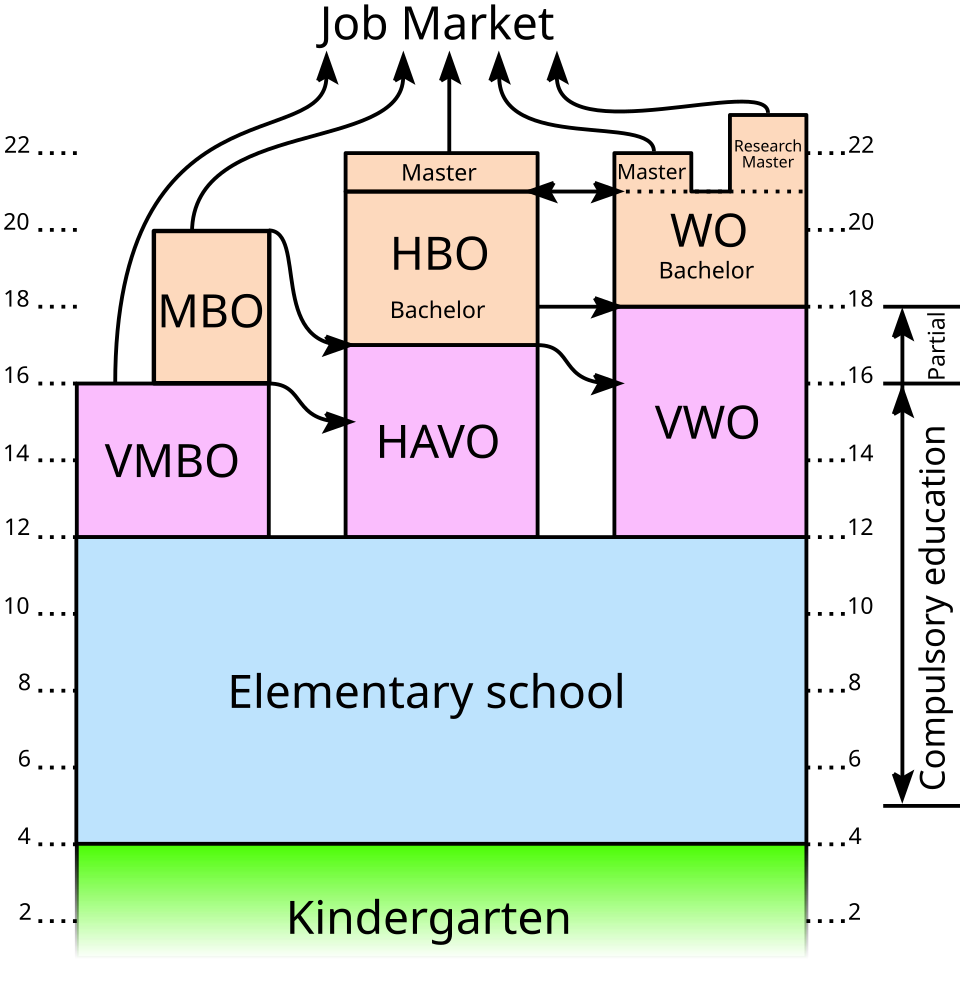
- Research universities (Wetenschappelijk Onderwijs, or WO): As implied, these type of programmes are focused on theory or academic research. WOs are aimed at specialised careers in sectors such as engineering, law, medicine or science.
The European Commission outlines that tuition fees in the Netherlands are:
- EU/EEA students: €2 530 per year (2024 – 2025, standard government-set rate)
- Non-EU/EEA students: €6 000 – €20 000 per year, depending on programme and institution
Practical tips for Settling in
While the Netherlands takes top spot for English proficiency among non-native speakers, learning some Dutch can enhance your experience and assist you with work, daily life, and social integration.
We offer a range of language courses, both in groups and one-to-one, specifically tailored to the ability and needs of you and your family.
Here’s some initial phrases to get you going:
- Hallo/Hoi (“Hah-loh/hoy”): Hello/Hi
- Tot ziens (“Toht Zeens”: )Goodbye
- Spreekt u Engels? (“sprayk yuh ehng-uhls”) : Do you speak English?
- Sorry (“Saw-ree”): Sorry/Excuse me
- Dank u wel(“Dahnk-ew-vehl”): Thank you
- Alstublieft (“ahlst-ew-bleeft”): Please
- Ya (“Yah”): Yes
- Nee (“Nay”): No
Register with your municipality within five days of arrival to ensure you receive your BSN. This is crucial to access banking, insurance, and work!
It can be pretty daunting moving away from your family and friends – particularly to a location with a different language.
Therefore, look out for expat groups, attend local events, and engage with the community to help you build a social network and make new friends in the Netherlands.
Did you know in the Netherlands there are more bikes than people?
Cycling is one of the main modes of transportation here, with the Netherlands having over 35,000km of dedicated cycle paths. It’s often faster and more cost effective.
Summary
Moving to and living in the Netherlands in 2026 can be an incredibly rewarding step, whether you are relocating for work, study, retirement or lifestyle.
With careful planning around residence permits, housing, healthcare and education, settling into Dutch life becomes far smoother and far less stressful. Starting early gives you the flexibility to make informed decisions, avoid delays, and focus on enjoying everything the Netherlands has to offer.
If you are considering a move, working with an experienced international relocation partner like Crown Relocations can help you navigate the process with confidence and make your transition to life in the Netherlands as seamless as possible.
If you are considering a move, working with an experienced international relocation partner like Crown Relocations can help you navigate the process with confidence and make your transition to life in the Netherlands as seamless as possible.
FAQs
A: UK citizens looking to reside in the Netherlands for more than 90 days will need to apply for a residence permit. There are different types of residence permits depending on the reason for your move.
A: It really depends where you live – in major cities like Amsterdam, the average one-bed apartment in the city centre costs €2,105.81pm, whereas smaller cities and towns can see prices closer €1,493.34pm.
A: Everyone that resides in the Netherlands is legally obliged to take out standard healthcare insurance. You can only do this once you have your Citizen Service Number (BSN).
A: It’s best to start planning 12-18 months before your intended move to allow time for visas, housing and school registration if needed.
